|
| Ecuador: four regions | 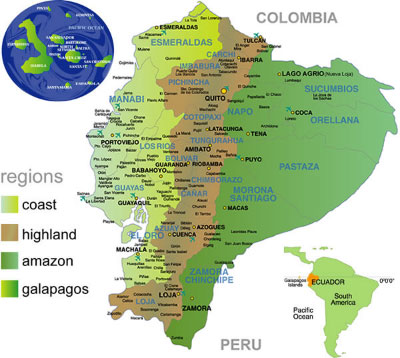 |
||||
| Andes or Highlands | |||||
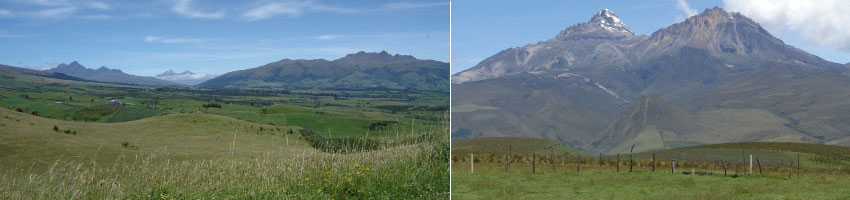
| The Andes, a long mountain chain with high snowed capped peaks, go through chilly high altitude grassland, magical landscapes, elegant patchwork covered hills and many micro-climates such as high barren plains, moorlands, tropical rainforests, dry Andean forests, subtropical cloud forests. “The Avenue of the Volcanoes” baptized by the German explorer Alexander von Humboldt, extends 600 km from the North (Ibarra) to the South (Cuenca) and numbers over 30 different volcanoes, among which 12 peaks over 5000m.
|
|||||
The Ecuadorian Andes are divided into three areas:
|
|||||
 |
|||||
| The Amazon rainforest | |||||
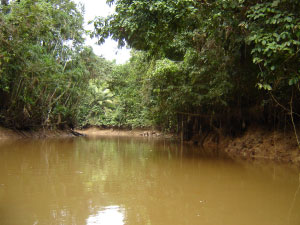
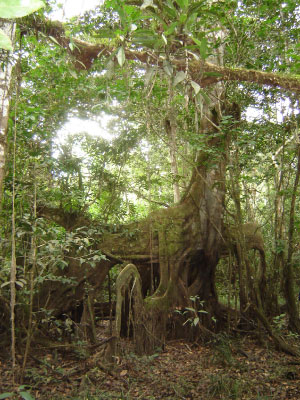
| The “Lungs of the Planet” cover 120.000 square kilometers of the country with lush & astonishing vegetation: some trees reach 45 m high! It is a mysterious and exotic place where lagoons and swamps abound with more than 600 various fish species including piranhas, and more than 250 amphibians and reptiles, for instance anacondas and caimans. The Amazon rainforest is also the habitat of numerous mammals such as pink river dolphins, armadillos, monkeys, tapirs, anteaters, and a wide variety of birds: sloths, toucans, parrots, macaws, and humming birds.
The area is also home to a number of indigenous groups: Sionas, Secoyas, Cofanes, Huaoranis, Quichuas, Shuars, and the Achuars . They live in harmony with the environment in an effort to keep their ancestral traditions and culture alive. |
 |
||||
|
|||||
| Pacific Coast | |||||
| With its 550 Km, it covers 25 % of the country and counts among its wonders beautiful golden and black sand beaches. A relaxing and inviting atmosphere, it is the best place to taste the variety of delicious seafood: ceviches, encocados, sango, cazuela, bandejas, parriladas de mariscos, etc. | |||||
| Galapagos islands | |||||
| UNESCO declared the Galapagos Islands a World Natural Heritage Site in 1978 and subsequently a World Biosphere Reserve in 1985. This archipelago is a living museum of evolutionary changes and extends over 8000 square kilometers in the Pacific Ocean about 1000 km off the West Coast of Ecuador. There are 13 large islands, 6 minors ones and more than 40 islets. The islands were formed by underwater volcanic eruptions from over one hundred volcanoes, some of which are currently still active. | |||||